John Will Interview
15 Oct 2005
John, thanks for your time today. You recently returned from yet another trip to North America. Can you tell us a little about this latest adventure?
Firstly, I have to say that I’m glad to be home. When I’m away, I miss my family and my time at my school. Now I get to be here [for] a few months before heading off again — just in time for the cold weather. This last trip, I had to head over to Quantico in Washington DC and spend some time with the M.A.C.E team on the Marines base. I was helping develop their curriculum — helping to put some structure and congruency into the program.
M.A.C.E — what does that mean?
The Martial Arts Centre of Excellence. The US Marine Corps are spending a lot of energy in the development of a strong martial arts (defensive tactics) program for their personnel. One of their new credos is ‘Every Marine a rifleman, every Marine a martial artist’. They are very committed to developing the best possible program and delivering it to every Marine, no matter where he or she may be based. A big undertaking. What type of tactics and training were you employed to teach at Quantico? Essentially, they had me out to develop their grappling program. And although we did several days on putting together a concise and easily deliverable ground package, it was really the structure and delivery methodology that I was trying to impart. These people are professional soldiers; possibly the last real warrior culture still intact on this planet. They understand the importance of being congruent with all that they do. They don’t want one culture in place when they are doing something like ‘armed room-clearance drills’ and another in place when they are grappling, then another when they are working standup techniques, bayonet fighting, or whatever. There has to be a single instructional methodology that runs throughout every facet of their training. There has to be tactical and strategic congruency in what they’re doing. This is important for the culture to hold up. And culture is extremely important in every warrior society — and particularly to the Marine Corps.
What are the tactical differences and subsequent training approach when working with these types of groups, compared to your average martial arts school?
This is not an easy question to answer. Professional soldiers are concerned with realism; not ego, not business, not in what looks good and has little function. These are people who are putting themselves in harm’s way on a regular basis; the tactics they employ have to have the very highest level of functionality possible. They are very different from your average martial artists in several ways. Firstly, they cannot afford to spend time working on techniques and strategies that have limited applications. They cannot be concerned with sporting applications or niceties. It all has to be real. Secondly, providing they are a highly professional group, they tend to participate in the training in a pro-active and intelligent way. They do not stand back and just blindly accept what the instructor says. They think about it and run it through their own personal ‘real-world experience’ filter; and then they will ‘pressure-test’ it to work out the kinks and uncover any weaknesses. Besides that, they usually have ‘kit’ to wear. This may mean 15 kilos of webbing, ceramic armour plating, an MP5 assault rifle slung over the shoulder, a nine-millimetre sidearm on their hip, etc. So techniques and strategies need to be rethought and modified to suit that dress and rethought again when taking unique environments into consideration.
How many techniques does a person in law-enforcement need to know?
It depends on what job they are doing. What a military policeman needs to know and what a deployed Marine needs to know are two different things. One is more concerned with restraint and control of fellow personnel, the other with survival in a live and hostile environment. Other specialised units within the
police force, for example, may have differing objectives depending on their jobs — anything from close personal-protection to special operations personnel and [those dealing with] armed offenders. They all have different needs, hence approaches to DT’s (Defensive Tactics) training. Some groups can get away with a few takedowns, restraints and cuffing techniques; others need a more comprehensive approach. It varies greatly.
You have been involved with training law-enforcement personnel on and off for the last 20 years. Can you tell us a little about the different groups you’ve worked with?
I have worked with the Victoria Police OST Unit (Operational Survival Training Unit), the Special Operations Group (counter terrorism arm of Victoria Police) as well as the AFP (Australian Federal Police), the ADF (Australian Defence Forces) in Canberra and other specialised groups of people within the law-enforcement community, both here and overseas. Some of this subject matter I would rather not talk about — suffice to say that most of the groups I’ve worked with are highly specialised and professional personnel who can afford to adopt nothing less than the very best practice when it comes to training and deployment due to the nature of their work.
Over the years, how has your technical approach changed and how does this compare with the types of requests you receive?
Spending time with various specialised groups has given me an understanding of how needs and techniques change depending on circumstance and applications. In working with professional law-enforcement groups or soldiers, one cannot think like a martial artist. I now have a very good overview of the world environment and an understanding of the needs of a variety of different types of personnel. My strength lies in my ability to put together a working curriculum or syllabus that suits the needs of a particular group; and then, perhaps more importantly, develop a delivery system that allows this syllabus to be disseminated in an efficient and highly effective manner. Often these people have limited time between training and deployment, so any material and training we cover has to be taken on board very efficiently. I would have to say that I’m far more adaptable now than I was, say, 10 years ago.
What was your involvement with the Indonesian military?
That was a long time ago and my involvement was very limited. I did some work in Indonesia doing drug buys and arrests, in which the military had some involvement. And at that time [back in the early ’80s], the military were big sponsors of the martial arts scene in Indonesia and so I was the beneficiary of some of that sponsorship. I was helped with some of my travel and living expenses when competing in Jakarta. I haven’t been there for some 20 years now.
You mentioned that you were at the MAIA (USA) conference this year. What was that like?
I was in Las Vegas last April for the annual MAIA convention (Martial Arts Instructors Association). They have a big expo every year and I was there this year both selling my Grappling Curriculum program as well as speaking at the expo. I also taught a few classes in the mornings for the UBBT Group (Ultimate
Black Belt Test) — a bunch of martial artists who are on a personal quest to push back their boundaries and experience new growth as martial artists. Some very nice people.
Can you tell us a little more about the grappling curriculum that you have developed, and who is already using it?
Myself and my US-based partner, David Meyer, have developed a fully professional grappling curriculum for school owners that want to teach grappling in their schools. Itis very comprehensive and there is nothing else on the market that compares to it. Right now, we have about 240 schools using it and it is growing in popularity every year. We have many Brazilian Jiu Jitsu Blackbelts using it, as it has a logical and very progressive structure, and so gets the very best result from the students. But mostly it is used by non-grapplers who don’t want to be left by the wayside, and who realise the need to incorporate some grappling/groundfighting into their curriculum or even offer it as a separate program. We have been approached by UFAF (United Fighting Arts federation) — Chuck Norris’ organisation — about the utilisation of our curriculum for their membership. This is a big step for UFAF, and so we will be at
their next convention (June 2006) to begin the delivery process and get them up to speed on it all. UFAF are in touch with the way things are heading; they are acutely aware that if they don’t offer a ground-fi ghting package as part of their syllabus, they stand a chance of falling by the wayside. The students that come into a martial arts school are just far more educated today than they’ve ever been in the past. People know that grappling is an important, if not inevitable, part of interpersonal combat; and so the professional instructor has a duty of care to provide it for his/her students if they are truly delivering skill-sets that can work in the real world. Rather than reinventing the wheel, many high profi le and highly skilled martial artists are adopting our curriculum — all the work has been done — and they can launch their grappling program, knowing they are employing absolute best practice. We are fairly busy with it all, particularly in the States.
What other projects do you have in the pipeline?
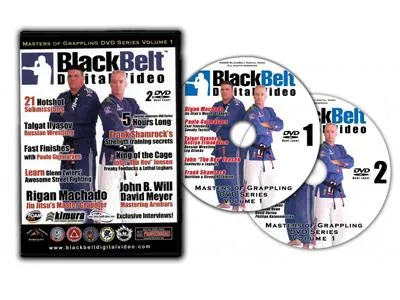
We are currently working on an end-user DVD series. This is aimed at the student, rather than the instructor; meaning it is relatively inexpensive and yet is structured with a very high level of detail. Our first two DVDs to come off the line will be Mastering Arm-bars and Mastering Chokes. We have a bunch to follow. Apart from that, I have more work to do in Washington later this year, as well as my usual stint of seminars throughout Australia and New Zealand. My year is full and each month seems busier than the last. Where is my fishing rod anyway? [John’s weakness is his passion for fly-fishing.]